AUGMENTED SYNERGY FOR ACCURATE & PARAMETRIC PROJECTS
CAD-BIM & AI CONVERGENCE: Reliability - Benefit - Innovation
By Markus Hormaza
FIRE PROTECTION SYSTEMS
Through the MORPHORISER spin-off, fire detection, alarm, preaction, and fire suppression systems are modeled, including sprinkler networks, vortex systems, and water mist systems. RedLine documentation is developed, along with code-compliant as-built deliverables and coverage simulations for water and high-density foam.
INFRASTRUCTURE FOR PRE-ACTION SYSTEM
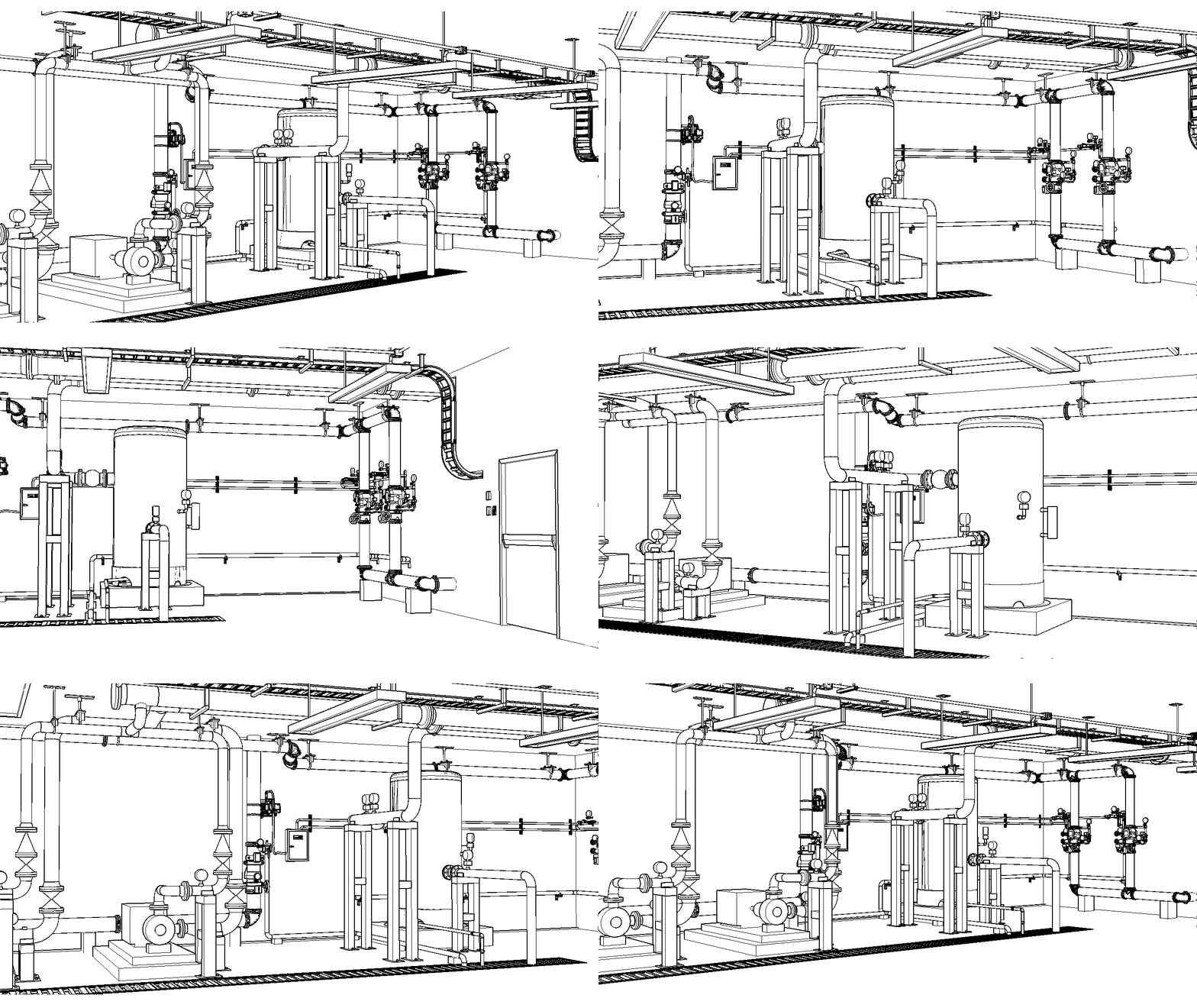
| | Project: INFRASTRUCTURE FOR PRE-ACTION SYSTEM | | Date: 03/02/2026 | | Prepared by: Markus Hormaza, Representative of ASAP PROJECTS © | | Objective: Development of hydraulically engineered CAD/BIM-based design for preaction fire protection systems under fire scenarios, in compliance with applicable NFPA standards for architectural and industrial infrastructure. The system is intended to ensure operational efficiency and immediate preaction response to critical events | | Design Phase: Detailed Engineering | | Skills: Application of Computer-Aided Design (CAD), BIM modeling, piping and preaction fire protection system design, and implementation of industrial standards | | General Description: The infrastructure has been designed and modeled within a CAD/BIM environment, accurately representing piping routing and the placement of Victaulic components. Scenario-based analyses aligned with U.S. standards are integrated to ensure operational integrity, effective fire suppression, and the development of technically sound response strategies | | Copyright: Original work. All rights reserved | | Tools: Autodesk, Inc. | | Applicable Codes and Standards: NFPA, ASME, AIA, ASTM, NACE | | Design Requirements: LOD 300 modeling to ensure dimensional accuracy, code compliance, and operational performance under critical conditions. Components are designed to withstand static and dynamic loads. The system includes pumping, storage, hydraulic routing, fittings, and Victaulic valves | | Materials: Ductile iron, copper, carbon steel, stainless steel, and Victaulic fittings, selected for corrosion resistance and demanding operational conditions | | Considerations: The project integrates CAD, BIM, and AI technologies to optimize preaction fire protection infrastructure design in architectural and industrial environments, ensuring technical traceability, operational efficiency, and regulatory compliance | | Contact: Markus Hormaza, hormazamarkus@gmail.com | | Rights: ASAP PROJECTS © All rights reserved | |
INDUSTRIAL WATER FIRE SUPPRESSION SYSTEM
![[GIF] SCI - AGUA INDUSTRIAL.gif](https://static.wixstatic.com/media/61b593_4eced905dd744f1887d8d822ee701ac9~mv2.gif)
| | Project: INDUSTRIAL WATER FIRE SUPPRESSION SYSTEM | | Date: March 2, 2020 | | Prepared by: Markus Hormaza, Representative of ASAP PROJECTS © | | Objective: Development of an industrial water fire protection system in accordance with NFPA regulations for the Oil & Gas industry, ensuring maximum safety and operational efficiency. The system is intended to mitigate fire risk and ensure the protection of assets and personnel at the crude oil filtration and storage station | | Design Phase: Detailed Engineering | | Skills: Application of Computer-Aided Design (CAD), Building Information Modeling (BIM), fire protection system design for the Oil & Gas industry, and implementation of industrial design standards | | General Description: The fire water system was designed and modeled using CAD/BIM technologies, providing a detailed representation of critical components and areas to ensure system operability and efficiency. Risk assessment, analysis, and planning of fire scenarios—including Jet Fires, Pool Fires, and Flash Fires—were implemented in alignment with international standards (NFPA, ASME, API, ASTM, NACE) to ensure operational integrity, reduce fire impact, and support the development of effective response, control, and mitigation strategies | | Copyright: Original work. All rights reserved | | Tools: Sprinkler, Victaulic CAD Library, AutoCAD, AutoCAD Plant 3D, Autodesk Revit, Inventor, Navisworks, Vectary | | Applicable Codes and Standards: NFPA 13 (Installation of Sprinkler Systems), NFPA 20 (Installation of Stationary Fire Pumps), ASME (American Society of Mechanical Engineers), API (American Petroleum Institute), ASTM (American Society for Testing and Materials), NACE (National Association of Corrosion Engineers) | | Design Requirements: LOD 300 modeling to ensure dimensional accuracy, proper connections, and material compliance with NFPA and ASME standards, guaranteeing system compatibility and performance under critical operating conditions. Modeled piping and fittings are designed to withstand static and dynamic loads, meeting strength and durability requirements. The fire protection system includes a pumping system, water storage tank, grooved piping, fittings, Victaulic pendent sprinklers, Cobra-type water monitors, and a valve manifold | | Materials: ASTM A36 carbon steel piping and Victaulic fittings, selected to ensure corrosion resistance and suitability for demanding operating conditions. Cobra-type valves in water monitors provide precise flow and pressure control, while Victaulic pendent sprinklers are designed to comply with NFPA 13 requirements for water density and coverage. The entire system is designed to meet the safety and efficiency standards required in the Oil & Gas industry | | Considerations: This project integrates advanced CAD, BIM, and AI technologies to optimize fire protection system design within the petrochemical sector | | Contact: Markus Hormaza, hormazamarkus@gmail.com | | Rights: ASAP PROJECTS © All rights reserved | |
HIGH EXPANSION FOAM FIRE EXTINGUISHING SYSTEM
![[GIF] SCI ESPUMA.gif](https://static.wixstatic.com/media/61b593_05d340968b6c46b3b5fbb72260a5b75d~mv2.gif)
| | Project: High-Expansion Foam Fire Suppression System | | Date: March 2, 2020 | | Prepared by: Markus Hormaza, Representative of ASAP PROJECTS © | | Objective: Design of a high-expansion foam–based fire protection system in accordance with NFPA standards for the protection of hydrocarbon storage tanks. The system is intended to prevent and control fires in critical areas, ensuring facility integrity and personnel safety | | Design Phase: Detailed Engineering | | Skills: Application of Computer-Aided Design (CAD), Building Information Modeling (BIM), fire protection system design for the Oil & Gas industry, and implementation of industrial design standards | | General Description: The high-expansion foam fire protection system includes a pumping system engineered to deliver the proper mixture of industrial water and foam concentrate. The system is designed in compliance with applicable safety standards to provide an effective emergency response. Risk assessment, analysis, and planning of fire scenarios—including Jet Fires, Pool Fires, and Flash Fires—have been implemented in alignment with international standards (NFPA, ASME, API, ASTM, NACE) to ensure operational integrity, reduce fire impact, and support the development of effective response, control, and mitigation strategies | | Copyright: Original work. All rights reserved | | Tools: Sprinkler, Victaulic CAD Library, AutoCAD, AutoCAD Plant 3D, Autodesk Revit, Inventor, Navisworks, Vectary | | Applicable Codes and Standards: NFPA 11 (Standard for Low-, Medium-, and High-Expansion Foam), NFPA 20 (Standard for the Installation of Stationary Fire Pumps), ASME (American Society of Mechanical Engineers), API (American Petroleum Institute), ASTM (American Society for Testing and Materials), NACE (National Association of Corrosion Engineers) | | Design Requirements: 3D LOD 300 modeling to ensure dimensional accuracy, proper connections, and material compliance with NFPA and ASME standards, guaranteeing system compatibility and performance under critical operating conditions. The system is designed to meet the flow and pressure requirements established in NFPA 11 for foam systems | | Components: Pumping system, industrial water supply, foam concentrate, supply manifold, water storage tank, foam chambers, and foam monitor with Cobra-type valve | | Materials: System components—including piping, fittings, and foam monitors—are specified using materials resistant to corrosion and the demanding operating conditions of the Oil & Gas industry. Piping complies with ASTM A53 standards, with fittings selected for compatibility with foam and water systems | | Considerations: This project integrates advanced CAD, BIM, and AI technologies to optimize fire protection system design within the petrochemical sector | | Contact: Markus Hormaza, hormazamarkus@gmail.com | | Rights: ASAP PROJECTS © All rights reserved | |
TAGS
#AutodeskInc., #BIM, #CAD, #Mechanical, #FireProtectionSystems, #ASME, #ASTM, #API, #NACE, #NFPA, #IEEE, #Oil&Gas, #Fittings, #Jack-UpBarge, #TexasFlange, #BonnetForge, #Victaulic, #ASAPPROJECTS, #PETROCADDESIGNS, #MarkusHormaza, #AI