AUGMENTED SYNERGY FOR ACCURATE & PARAMETRIC PROJECTS
CAD-BIM & AI CONVERGENCE: Reliability - Benefit - Innovation
By Markus Hormaza
PIPING DESIGN
Through the PETROCADDESIGNS spin-off, industrial piping networks are developed, including 3D models, layouts, plot plans, key plans, isometric line spools, data extraction, and technical specifications. The scope also includes immersive models, renderings, RedLine surveys, and As-Built documentation for project validation, updates, and multidisciplinary coordination.
ATMOSPHERIC DISTILLATION SYSTEM FOR HEAVY CRUDE OIL
![CRUDE OIL DISTILLATION SYSTEM [PRESENTATION BY MARKUS HORMAZA].gif](https://static.wixstatic.com/media/61b593_27a67d0194a84acc9bae577cf85a43aa~mv2.gif)
| | Project: ATMOSPHERIC DISTILLATION SYSTEM FOR HEAVY CRUDE OIL | | Date: 02/11/2024 | | Status: Under construction, continuously updated | | Prepared by: Markus Hormaza, representative of ASAP PROJECTS © | | Objective: To develop a high-fidelity, multidisciplinary 3D digital model for an atmospheric distillation system applied to heavy crude oil at the tertiary processing stage, aimed at supporting detailed engineering, advanced technical coordination, and data-driven decision-making. The objective includes ensuring the mechanical and operational integrity of the piping system, optimizing material and component traceability, reducing physical and functional interferences among disciplines, and enabling a BIM/VDC environment that functions as a progressive digital twin for constructability analysis, erection sequencing, safe operation, and future optimization or expansion stages of the industrial process | | Design Phase: Detailed Engineering | | Project Scope: The scope comprises the comprehensive and coordinated design of a tertiary heavy crude oil distillation system, subsequent to primary separation processes, gas extraction, and handling of by-products such as coke, incorporating process, industrial safety, and maintainability criteria. It includes detailed modeling of process and utility piping, static and dynamic equipment, steel structures, supports, pipe racks, operational access systems, instrumentation and control systems, automation, electrical power systems, associated civil works, and fire protection systems in accordance with international standards. The project includes the development of a collaborative BIM model with intelligent parametric objects, standardized coding, associated technical documentation (isometrics, layouts, MTOs, line lists, specifications), detection and resolution of interferences (hard/soft clashes), definition of construction sequences and 4D planning, as well as preparation of the model for future integration with operational simulations, risk analysis, maintenance, and asset management. Scope updates are continuous and evolve in accordance with interdisciplinary coordination progress and design maturity | | Standardization Codes: ASME, API, ASTM, NACE, NFPA, IEC, ANSI, NEC. Certified digital libraries from recognized manufacturers are incorporated | | Applied Skills: Advanced CAD-BIM management, interdisciplinary 3D modeling, technical coordination, mechanical design, piping design, digital quality control, and administration of standardized technical content | | Technologies Used: CAD/BIM: Autodesk, Inc. – BIM/VDC: Multidisciplinary coordination, clash detection, 4D planning, and document control within CDE environments – AI: Immersive visualization (VR/AR), integration of intelligent search engines, technical recommender systems, and automation of construction solutions | | LOD (Level of Development): LOD 100 in progressive transition toward LOD 100 | | Designed Components: Tertiary distillation column, tank, heat exchangers, reboiler, structural supports, pipe racks, access and operation systems on the processing platform, industrial automation, industrial safety elements, and fire protection systems | | Materials: Structural steel in accordance with ASTM A36 and ANSI 360-16, piping and fittings per ASME B16.5, coatings in accordance with NACE RP-0169 | | Software and Collaborative Environment: Autodesk Suite (Inventor, AutoCAD, Revit, Navisworks Freedom), Common Data Environment (CDE) platforms, simulation, control, and immersive visualization tools enhanced with AI | | Considerations: This technical data sheet focuses on a complex system under evolution, corresponding to a tertiary stage of processed crude oil distillation. It applies collaborative BIM methodologies supported by artificial intelligence for visualization, technical validation, and data-driven decision-making. Updates are continuous and depend on ongoing disciplinary integrations | | Contact: Markus Hormaza, hormazamarkus@gmail.com | | Rights: ASAP PROJECTS ©. All rights reserved | |
HEAVY CRUDE OIL STIMULATION AND PRODUCTION SYSTEM
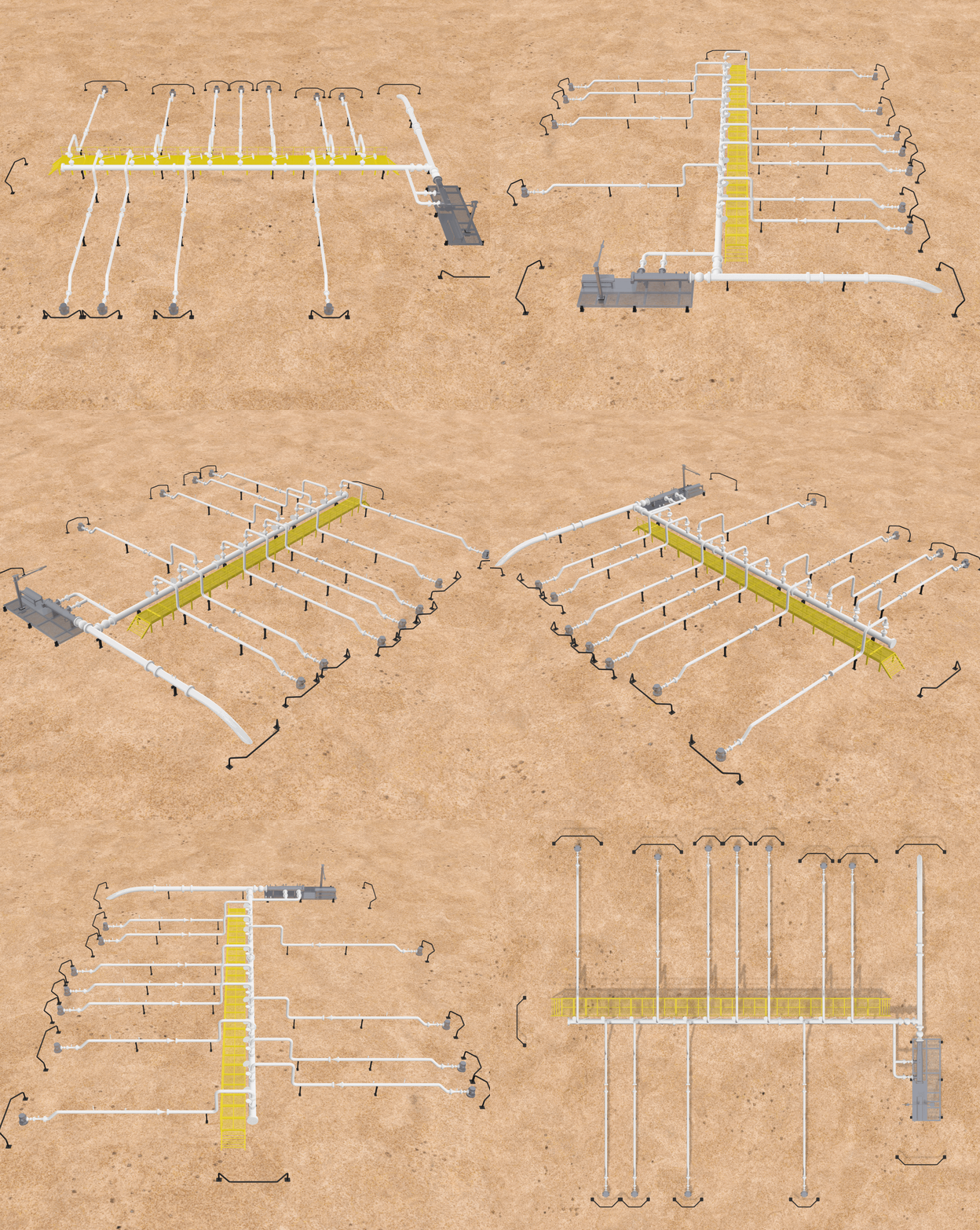
| | Project: HEAVY CRUDE OIL STIMULATION AND PRODUCTION SYSTEM | | Date: 03/10/2025 | | Prepared by: Markus Hormaza, representative of ASAP PROJECTS © | | Objective: Proprietary work through interpretation, digitization, modeling, and pipeline design for stimulation and heavy crude oil extraction infrastructure in an oil field | | Design Phase: Detailed Engineering | | Skills: Application of Computer-Aided Design (CAD) technical drafting, piping design, CAD administration and parameterization for standardized digitization and modeling in accordance with international standards | | Project Scope: Interpretation and design of piping systems for heavy crude oil stimulation and extraction, including blowout preventers, well manifolds, pipeline connection, and maintenance | | General Description: A three-dimensional model of the stimulation and heavy crude oil extraction piping system is developed, focused on optimizing visualization and understanding of reservoir operations. This technical representation enables analysis of standard infrastructure, evaluation of operational flows, and planning of pipeline maintenance. Three-dimensional modeling facilitates the identification of classified areas, including multi-well stimulation zones, and enables simulation of intensive operational scenarios | | Copyright: Proprietary work. All rights reserved | | Software Platform: Autodesk, Inc. | | Standardization Codes and Standards: ASME, API, ASTM, NACE, NFPA | | Design Requirements: Proprietary standardized digitization and modeling for piping design during the stimulation and heavy crude oil extraction stage. A Level of Development (LOD) 350 ensures dimensional accuracy and regulatory compatibility. Piping design focuses on the self-supporting capacity of the piping system, with flexibility under static and dynamic loads. Structural validation is considered for operation in desert environments and seismic activity zones | | Skills: CAD administration, technical drafting, standardized and parametric 3D modeling, piping design, mechanical equipment drafting, adaptation of vendor and equipment information, geometric detailing | | Required Expertise: Reservoir engineering, knowledge of petrochemical processes, digitization, 3D modeling, familiarity with international Oil & Gas standards, piping design | | Technologies Used: CAD, BIM, and immersive AI | | LOD (Level of Detail): LOD 300 | | Designed Components: Pig Launcher Skid Unit [intelligent pig], BOP-type well blowout preventers, structural walkway for circulation and valve operation, pipeline bayonet design, cathodic protection layout, piping design, flanged connections, reinforced branch connections, support distribution, hydraulic optimization of routing for efficiency and operational flexibility | | Documentation Produced: 2D technical drawings, 3D modeling, shop drawings, assembly details, mechanical equipment part breakdowns, generation of isometric line spools, selective data extraction, technical specifications, AI-augmented simulation for immersive visualization and interaction, modular 3D and 4D printable prototype development at commercial scale | | Materials: Structural steel piping and profiles ASTM A36 Grade B, ASME B16.5 flanged connections, graphite/SS spiral-wound gaskets per ASME B16.20, anticorrosive coatings per NACE RP-0169, temperature and pressure measurement instrumentation for continuous monitoring, and position indicators for intelligent pigging tools | | Considerations: This technical datasheet emphasizes international regulatory compliance within the context of Oil & Gas piping design during the stimulation and heavy crude oil extraction stage. Design, simulation, immersion, and additive prototyping technologies are applied, including artificial intelligence for augmented interaction | | Contact: Markus Hormaza, hormazamarkus@gmail.com | | Rights: ASAP PROJECTS © All rights reserved | |
PROGRESSIVE ENGINEERING FOR OIL & GAS PROJECT
![CRUDE OIL REFINING STATION [PRESENTATION BY MARKUS HORMAZA].gif](https://static.wixstatic.com/media/61b593_dd64d75d83c5499fb8a457be1df5372a~mv2.gif)

Dossier: https://oilportfolio.pb.design/
Immersive 3D Model with IA [Vectary, Inc.]: https://app.vectary.com/p/33ULVwDmWfnJcNYYXOExZB
| | Project: PROGRESSIVE ENGINEERING FOR OIL & GAS PROJECT | | Date: 02/03/2020 | | Prepared by: Markus Hormaza, representative of ASAP PROJECTS © | | Objective: Development of a multidisciplinary engineering project through CAD/BIM-assisted digitization, modeling, and parametrization, applied to petrochemical infrastructure | | Resource Used: Project Nature: Artificial intelligence-assisted reengineering applied to refined hydrocarbon storage. The starting point was a conceptual 2D sketch, originally developed within the framework of a professional and personal relationship with a colleague, and later abandoned. This input was never formally contractually recognized nor financially compensated | Transformation and Disassociation: After the conclusion of that relationship, the author took back the sketch in their possession and completely redesigned it, eliminating any link to the prior emotional or intellectual origin. The new development is based on standardized 3D modeling according to Oil & Gas industry standards, incorporating artificial intelligence to optimize visualization, interaction, and digital functionality | Technical Evolution: Just as crude oil requires refining to achieve its value, this project has undergone a continuous process of technological evolution: BIM modeling and immersive simulation - Potential integration with extended reality (XR) - Feasibility for 3D and 4D additive prototyping. This is not a nostalgic recovery, but a legitimate technical appropriation oriented toward creative resilience and the enhancement of professional skills | Legal and Ethical Position: The author declares: Having received no compensation for the original input - Being unaware whether the other party managed the material with third parties - Possessing metadata, traceability, and native proof of authorship - Being open to dialogue in response to any claim, as well as to initiating formal actions to seek compensation for their work, in accordance with copyright principles and professional ethics | Conclusion: The project is today a mature, integral technical proposal, disassociated from its uncertain origin, and aligned with cutting-edge operational and technological demands. What was once a personal act has been sublimated into a legitimate professional development, suitable for immersive, collaborative, and augmented environments. | | Design Phase: Detailed Engineering | | Skills: Application of Computer-Aided Technical Drawing (CAD), BIM (Building Information Modeling), piping design in the Oil & Gas industry, implementation of industrial design standards | | Project Scope: The project consists of the projection and modeling of a standardized petrochemical project within the context of Proprietary Work | | General Description: The 3D model developed using CAD/BIM technology provides a detailed representation of key elements within a crude oil processing station. This model facilitates operational assessment, flow analysis, and maintenance planning. Through a regulatory approach based on international standards (ASME, API, ASTM, NACE), the model ensures the structural and operational integrity of the system, optimizing its performance for the filtration and storage of crude oil derivatives | | Copyright: Proprietary work. All rights reserved | | Tools: AutoCAD, AutoCAD PLANT 3D, Autodesk Revit, Inventor, Navisworks, Vectary (virtual immersion and interaction) | | Standardization Codes and Standards: ASME (American Society of Mechanical Engineers), API (American Petroleum Institute), ASTM (American Society for Testing and Materials), NACE (National Association of Corrosion Engineers), NFPA (National Fire Protection Association) | | Design Requirements: 3D modeling at LOD 350 to ensure dimensions, connections, and materials compliant with ISA, ASME, API, and ASTM standards, guaranteeing system compatibility and operability under critical operating conditions. Modeled piping and structures have been designed to withstand both static and dynamic loads | | Skills: Advanced administration of CAD/BIM platforms, piping design and modeling in accordance with international standards, industrial system parametrization | | Required Expertise: Extensive knowledge in Oil & Gas process engineering, 3D modeling of industrial systems, application of international standards and design regulations, technical modeling and representation | | Technologies Used: CAD (Computer-Aided Design), BIM (Building Information Modeling), AI (augmented reality technologies and artificial intelligence for operational simulation and interactive immersion – Vectary) | | LOD (Level of Detail): LOD 350 (detailed precision for analysis and operational planning) | | Designed Components: Topographic adaptation, civil works, steel structures, tank and vessel design, pump and filter specification, carbon steel piping, flanged connections with spiral-wound gaskets, optimization of pipe supports and piping system layout to improve hydraulic and operational efficiency, stormwater system, oily water system, lighting and electrical duct systems, industrial automation system, shielding system, grounding and cathodic protection, fire protection system, architecture | | Generated Documentation: 3D modeling, fabrication and assembly documentation for tanks and equipment, bills of materials, and technical specifications. Augmented virtual immersion technology has been implemented for visualization and analysis | | Materials: ASTM A36 structural steel pipes and profiles, flanged connections and components in accordance with ASME B16.5, anti-corrosion coatings compliant with NACE RP-0169 standards. The system includes control valves and actuators, as well as sensors for continuous monitoring of operational conditions (temperature and pressure) | | Considerations: This project integrates advanced CAD, BIM, and AI design technologies to optimize a petrochemical design | | Designer: Markus Hormaza, hormazamarkus@gmail.com | | Rights: ASAP PROJECTS © All rights reserved | |
PIPING SPOOL FOR WORKSHOP PREFABRICATION AND ON-SITE ASSEMBLY
![INGENIERÍA Y ENSAMBLAJE DE PIPING INDUSTRIAL [BANNER]](https://static.wixstatic.com/media/61b593_dd204a4c95d7478cb308083b38d02b83~mv2.gif)
| | Project: PIPING SPOOL FOR SHOP PREFABRICATION AND ON-SITE ASSEMBLY | | Prepared by: Markus Hormaza, representative of ASAP PROJECTS © | | Objective: Design, prefabrication, and assembly of pipeline spools for the interconnection of tanks, pumps, and various equipment within an industrial infrastructure, which required project management from on-site dimensional surveying through final installation, ensuring accuracy and regulatory compliance | | Design Phase: Design, Prefabrication, and Assembly | | Highlighted Skills: Geometric and mathematical design applied to piping – Interpretation and generation of piping spool isometric drawings – Digital modeling and CAD-BIM documentation development – Quality control in design, prefabrication, and assembly – Spatial coordination and resolution of installation issues – Dimensional verification and technical auditing on site | | Project Scope: Supervision and development of piping spool design for industrial infrastructure, considering: Design and documentation [Development of isometric drawings, part breakdowns, and technical specifications for fabrication], Workshop prefabrication [Verification of cuts, welds, and assemblies in accordance with design specifications and applicable standards], and On-site installation [On-site coordination, validation of alignments, and final adjustments for proper interconnection of piping systems] | | General Description: The project involved the generation and validation of isometric drawings for spool fabrication in a specialized workshop, ensuring compliance with dimensional tolerances and technical specifications. Direct supervision of cutting, assembly, and welding processes was conducted, verifying procedures and regulatory compliance at each phase. Subsequently, on-site installation was monitored, including field adjustments, redesigns, and technical resolutions in coordination with existing infrastructure, ensuring system commissioning | | Tools and Software Used: AutoCAD, Navisworks, AutoCAD Plant 3D, and metrology tools and applications for dimensional verification | | Applied Standards: ASME, API, AWS, ASTM, NFPA | | Design Requirements: Development and validation of piping spool drawings in accordance with project specifications. Coordination with engineering, fabrication, and installation teams. Application of geometric and spatial principles for optimized piping design. Ensuring dimensional accuracy and compliance with industrial standards. Prefabrication auditing and on-site installation verification | | Required Expertise: Piping modeling and design – Knowledge of materials and fabrication processes – Inspection and quality assurance in piping fabrication – Application of international standards – Resolution of technical issues on site | | Designed Components: Piping spools for the interconnection of tanks, pumps, and process equipment. Structural supports and anchors for the piping system. Field adjustments for alignment with existing infrastructure | | Generated Documentation: Piping spool isometric drawings. Assembly details and fabrication specifications. Inspection reports and dimensional verification records. Records of on-site adjustments and modifications | | Considerations: This project represents a comprehensive and significant experience in industrial piping development, encompassing activities from geometric design through technical auditing on site. Markus Hormaza’s involvement in the design, prefabrication, and installation processes ensures dimensional accuracy and system compliance, providing efficient solutions aligned with international standards | | Contact: Markus Hormaza, hormazamarkus@gmail.com | | Rights: ASAP PROJECTS ©. All rights reserved | |
TAGS
#AutodeskInc., #BIM, #CAD, #Mechanical, #ASME, #ASTM, #API, #NACE, #NFPA, #OffshoreStandards, #Oil&Gas, #P&ID, #Fittings, #Jack-UpBarge, #Ergil, #TexasFlange, #BonnetForge, #ASAPPROJECTS, #PETROCADDESIGNS, #MarkusHormaza, #AI