AUGMENTED SYNERGY FOR ACCURATE & PARAMETRIC PROJECTS
CAD-BIM & AI CONVERGENCE: Reliability - Benefit - Innovation
By Markus Hormaza
SPECIALTIES
SPECIALTIES
Markus Hormaza, CAD Manager in engineering and architectural projects, has consolidated a multidisciplinary approach to technical planning, standards-compliant 3D modeling, and digital documentation for the AEC industry (Architecture, Engineering, and Construction). Each specialty is addressed through CAD–BIM methodologies, integrating artificial intelligence (AI) to optimize visualization, interdisciplinary interoperability, and document traceability within collaborative environments.
Through a set of specialized spin-offs, ASAP Projects delivers advanced technical solutions for each discipline, ensuring geometric accuracy, regulatory compliance, and operational efficiency across all phases of the project life cycle.
INTEGRATIONS WITH SPIN-OFFS
1. Architecture
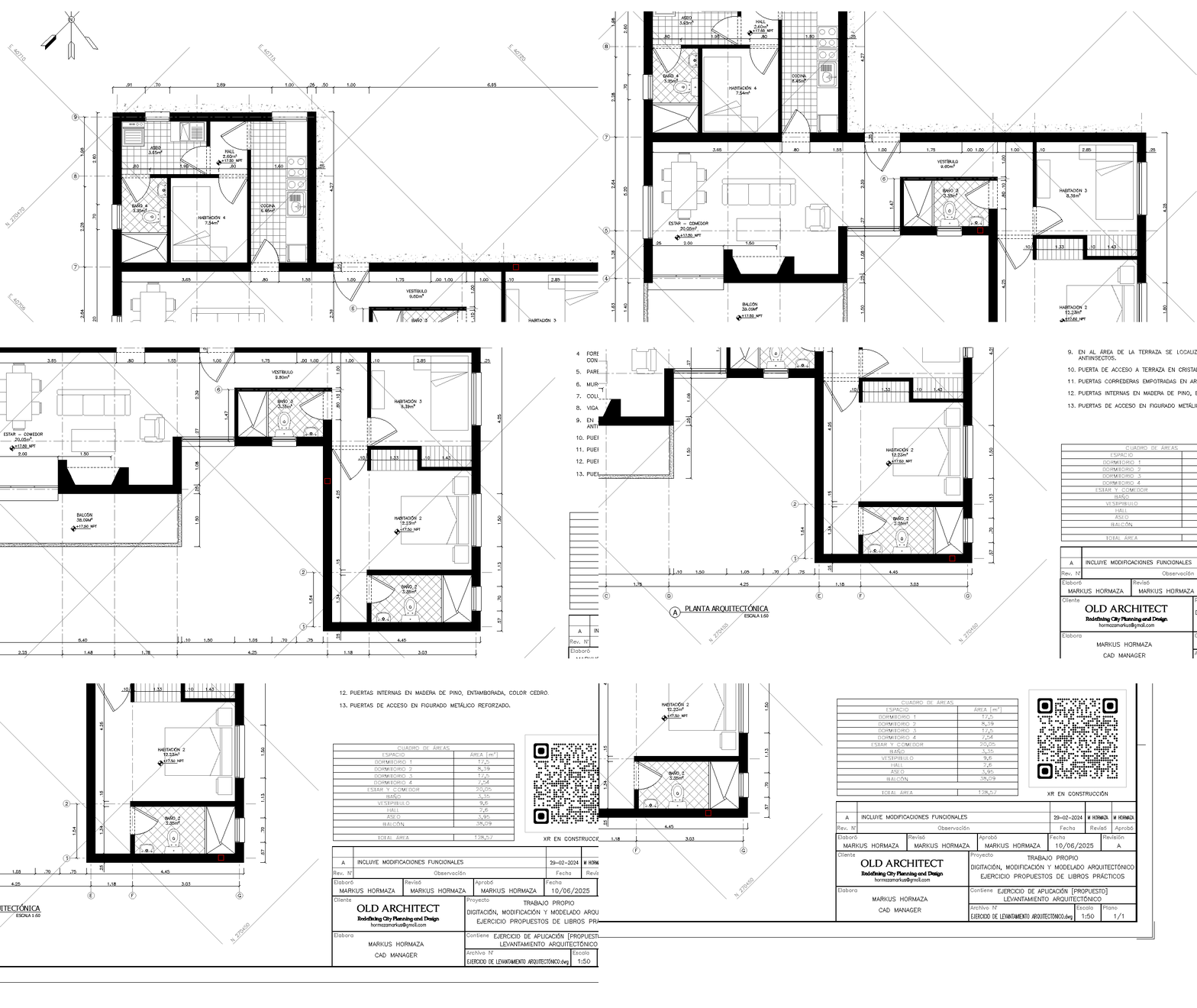
Through the VECTRUM spin-off, detailed architectural models, construction details, and standardized architectural drawing sets are developed. This also includes surveys of existing buildings for the preparation of As-Built documentation, with a focus on regulatory submissions to urban planning authorities. AI enables spatial performance forecasting, the creation of virtual collaborative environments, and the optimization of design decisions.
2. Furniture
Through the SOMA spin-off, architectural interior design is developed. This approach enables the design of kitchens, bathrooms, and lobbies, generating adaptive and customized furniture components through technical surveys, parametric modeling, and the production of shop drawings for CNC manufacturing or artisanal fabrication based on a technical dossier.
3. Civil Engineering
Through the HERCULEAN DESIGNS spin-off, structures and civil works are designed using parametric modeling, clash detection, and integration with existing infrastructure. The BIM methodology allows the anticipation of construction conflicts and effective coordination of disciplines in highly complex projects.
4. Steel Structures
Through the MANTISSTEEL spin-off, steel structural systems are modeled, including connection types, construction details, standardized drawing sets, extraction of construction data, and assembly documentation.
5. Industrial Processes
Through the PETROCADDESIGNS spin-off, industrial process diagrams are developed, including Piping and Instrumentation Diagrams (P&ID) and Process Flow Diagrams (PFD), either as design deliverables or As-Built documentation. The scope covers Oil & Gas, chemical processes, cosmetics, wastewater treatment, and food manufacturing processes.
6. Mechanical Engineering
Through the ASMECHANICAL spin-off, equipment, tanks, vessels, and mechanical systems are designed using parametric modeling, exploded views, assemblies, and simulations. This includes reverse engineering and the generation of As-Built documentation for maintenance and manufacturing.
7. Metalworking and Machining
Through the MECANIUSFORGE spin-off, parametric technical drawings and 3D modeling of metalworking components are developed, including turned and milled parts and assemblies. Digital twins are generated and configured for computer-aided manufacturing (CAM) processes and CNC setup for industrial machining.
8. Piping Design
Through the PETROCADDESIGNS spin-off, industrial piping networks are designed, including 3D models, layouts, plot plans, key plans, isometric spools for flow lines, selective data extraction, and technical specifications. This also includes immersive models, renderings, construction details, RedLine surveys, and As-Built documentation for project validation, updates, and multidisciplinary coordination.
9. Fire Protection Systems
Through the MORPHORISER spin-off, fire detection, alarm, pre-action, and suppression systems are modeled, including sprinkler networks, vortex systems, and water mist systems. RedLine documentation, code-compliant As-Built deliverables, and coverage simulations for water and high-density foam systems are developed.
10. Ingeniería Eléctrical Engineering
Through the TESLADRAFTER spin-off, low- and medium-voltage electrical networks are designed, including 3D modeling, single-line diagrams, and As-Built documentation. Expertise includes hydroelectric generation, transformation, and standardized distribution design. The BIM methodology facilitates coordination with other disciplines and regulatory validation.
11. Industrial Automation
Through the CONTROLOGIC CAD spin-off, automated system diagrams are developed, including sensors, actuators, system architecture, and control logic. Electronic schematics, control diagrams, and functional As-Built documentation are produced for integration in industrial environments such as Oil & Gas, chemical processes, cosmetics, wastewater treatment, and food manufacturing.
12. Additive Prototyping
Through the ZLAYER+ spin-off, models for 3D printing in polymers and composite materials are developed. Geometry is optimized for modular additive manufacturing, generating digital twins and assembly simulations to achieve material and dimensional accuracy.
13. Jewelry Design
Through the MARKUS & CO. spin-off, highly detailed jewelry prototypes are modeled, enabling immersive visualization, personalized collaboration, and preparation for 3D printing or casting.
14. Scenographic Design
ÉKPHRASIS is a spin-off company that develops projects integrating architecture, audio, and lighting. With the implementation of AI, it allows for anticipating spatial performance, simulating lighting and acoustic atmospheres, and generating virtual collaborative environments that optimize design decisions for large-scale events.
15. Interactive Educational Applications for Chldren
Immersive applications for children’s learning are developed, integrating 3D modeling, tactile interaction, and behavioral simulations. This approach promotes cognitive and behavioral skills through virtual environments.
16. Animation and Video
Technical animations, walkthroughs, and explanatory videos are developed for process simulation, as well as for the review and presentation of prototypes, projects, and scenarios.
17. Digital Illustration
Technical product images and industrial representations are created using Illustrator and Photoshop, oriented toward brochures, manuals, and regulatory presentations.
18a. AI Rendering
Application of industrial materials and technical visualization on CAD models through artificial intelligence. Its implementation facilitates documentation, communication, and visual creativity in industrial and Oil & Gas contexts.
18b. AI Modeling
Generation and geometric modification of CAD models through artificial intelligence, optimizing creativity, efficiency, and interdisciplinary coordination. Its implementation accelerates the redesign of geometries and enables exploration of design alternatives with algorithmic support.
19. Digital Sculpture
Organic and sculptural forms are modeled using Autodesk Mudbox, with applications in art, conceptual design, and prototyping. The process enables volumetric exploration, texturing, and export for 3D printing and interoperability with other applications or scopes.
20. Experiential Digital Brand Extension
Immersive digital environments are developed for brand exhibition, integrating museographic design, interactive catalogs, and metaverse experiences. CAD-BIM technologies are employed to model navigable virtual spaces, enabling three-dimensional visualization of products, processes, or institutional concepts. Artificial intelligence optimizes user-space interaction, facilitating personalized immersive tours, behavior analysis, and real-time feedback. This specialty enhances brand narrative through symbolic, adaptable, and scalable digital architecture.
21. Video Game Concept
Technical and narrative concepts for video games are developed, integrating 3D modeling, level design, interactive logic, and virtual environment simulation. The process includes structuring game mechanics, visualizing characters and scenarios, as well as documenting operational flows for game engines such as Unity and Unreal Engine. CAD tools are used for base geometry and complemented with BIM technologies when precise architectural environments are required. Artificial intelligence enables adaptive behaviors, optimizes user experience, and facilitates collaborative iteration.
22. Utility Models
Functional models are developed with practical applications in industrial processes, architecture, and design. Technical utility is documented, CAD modeling is generated, and documentation is prepared for intellectual property registration.
CONSIDERATION
Each discipline is addressed with technical rigor and aligned with the highest industry standards. Workflows that incorporate As-Built documentation and/or artificial intelligence as visualization and collaboration tools enable the delivery of optimized, coordinated solutions for complex projects.