AUGMENTED SYNERGY FOR ACCURATE & PARAMETRIC PROJECTS
CAD-BIM & AI CONVERGENCE: Reliability - Benefit - Innovation
By Markus Hormaza
UTILITY MODELS
Functional models with practical application in industrial processes, architecture, and design are developed. Technical utility is documented, CAD modeling is generated, and documentation for intellectual property registration is prepared.
INVERTED RECLINING CHAIR
![SILLA RECLINABLE INVERTIDA [GIF].gif](https://static.wixstatic.com/media/61b593_475304a126f44bacbe38eaaf6e357332~mv2.gif)
| | Project: INVERTED RECLINING CHAIR | | Scope: Utility Model | | Author and Rights Holder: Markus Hormaza | | Classification: Industrial Design – Ergonomic Furniture / Architectural Equipment | | Year of Development: 2025 | | Status: Functional Conceptual Prototype | | General Description: Utility model for an ergonomic chair featuring an inverted seating position with forward inclination and a fixed structural anchorage to the floor slab. This design transfers vertical loads directly to the substrate, providing a stable and efficient seating solution for operational environments that require prolonged alertness and sustained postural support | | Field of Application: High-density institutional and commercial dining areas. Technical workspaces. Compact or operational accommodations in transportation and aerospace environments | | Technical Characteristics: Structure: Cold-rolled ASTM A36 carbon steel. Anchorage: Direct fixation to the floor slab using M10 expansion anchor bolts with anti-vibration washers. Mechanism: Reclining and return action via dual helical compression springs made of tempered SAE 1070 steel, combined with an adjustable pneumatic damper. Seat Surface: Option of perforated metal or fiber-reinforced polymer (FRP) composite with high-density, non-slip viscoelastic foam padding. Dimensions: 400 mm (W) x 520 mm (D) x 780 mm (H). The design is scalable for modular production | | Operating Principle: The user disengages a latch to release the chair from its vertical stowed position. The spring and pneumatic mechanism controls the forward descent into the working position. This negative seat angle promotes anterior pelvic tilt, aligning the spine and encouraging an active, upright torso posture conducive to tasks requiring sustained concentration. The mechanism automatically returns the chair to the stowed position when unoccupied | | Innovation and Uniqueness: 1. Fixed Installation: First reclining chair design intended for permanent architectural integration, eliminating floor footprint and instability. 2. Active Posture: Applies biomechanical principles derived from equestrian seating and task furniture to standard seating, counteracting slouched sedentary posture. 3. Modular Utility: The anchored base and scalable form factor enable integration into built-in furniture systems and space-restricted environments. 4. Sensor-Ready Design: The structure and mechanism allow for future integration of posture or occupancy sensors | | Design Rationale: This chair addresses the need for space-optimized, performance-oriented furniture in high-occupancy and technically demanding environments. It reinterprets traditional seating by prioritizing sustained task engagement over passive rest, aligning user posture with functional efficiency | | State of the Art and Market Opportunity: There is currently no commercially available furniture product that combines a forward-inclined seat, a reclining mechanism, and permanent architectural anchorage. This represents an unmet niche within interior architectural furniture, where space efficiency, stability, and user performance are critical | | Design Standards: Designed to comply with ISO 7173:2017 (strength and durability testing for chairs). Safety: Non-slip seat surface (coefficient of friction ≥ 0.8). Structurally validated for a static load of 150 kg. Maintenance: Annual inspection and servicing of the spring-damper mechanism and anchorage points are recommended | | Conclusion: This utility model introduces a new category of furniture product: the performance-oriented, architecturally integrated task chair. It merges structural engineering with ergonomic design to deliver a space-saving seating solution for demanding environments | | Rights: Utility Model developed by Markus Hormaza. All industrial design and intellectual property rights reserved | |
BRAILLE TALKING BOARD - ARTIFACT DESIGN FOR HORROR FILM
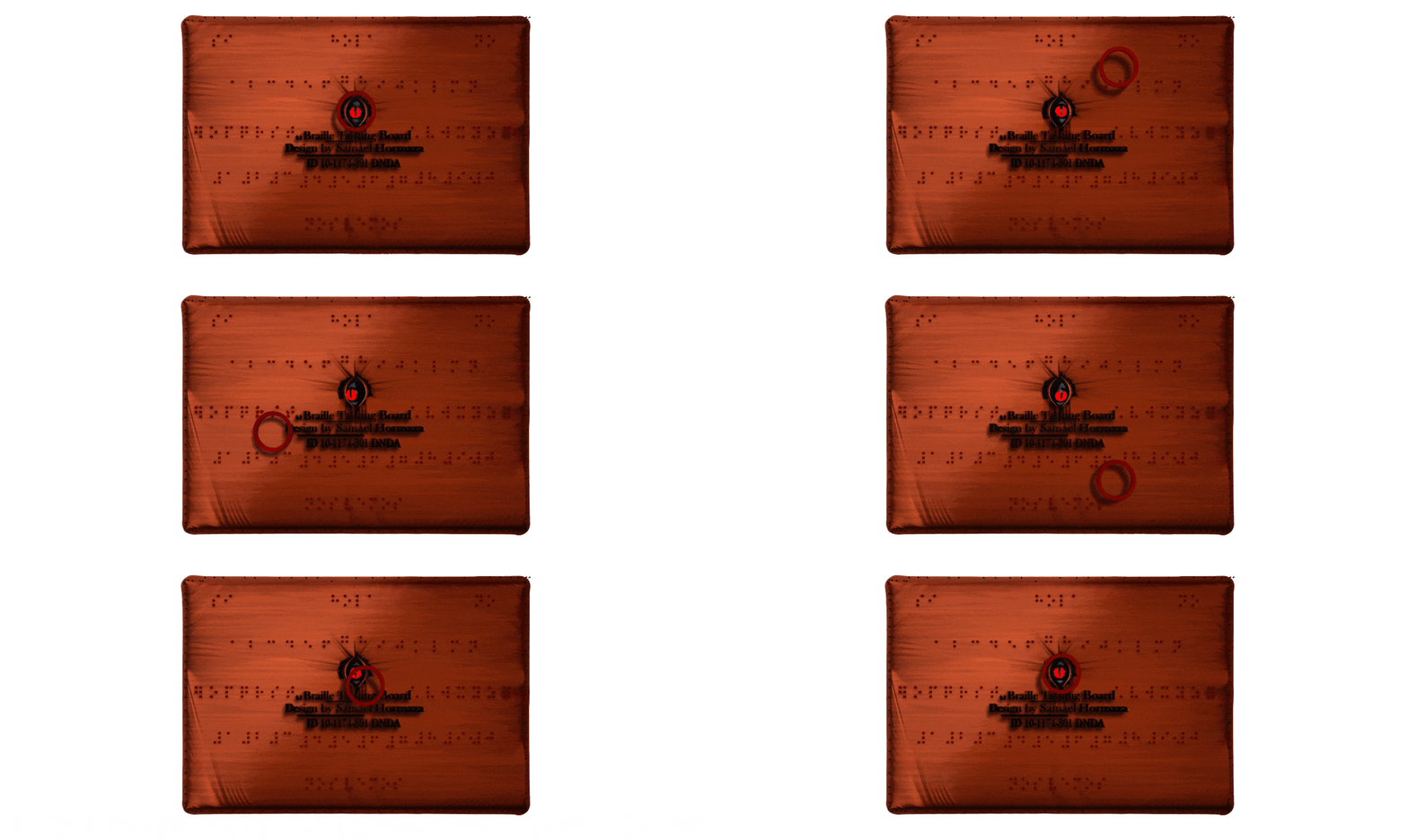
| | Project: BRAILLE TALKING BOARD - Artifact Design for Horror Film | | Scope: Utility Model | | Author and Utility Model Holder: Markus Hormaza | | Registration: ID 10-1174-301 [DNDA Colombia, 2023] | | Classification: Industrial Design – Entertainment Object [Horror Culture] | | Year of Development: Since 2022 | | Status: Functional wooden prototype | | General Description: The Braille Talking Board is a utility model that fuses the ancestral Ouija board with the Braille code, reinterpreted by Markus Hormaza as an inclusive design and adult entertainment artifact. Its fully wooden structure features Braille code inscriptions, either embedded or embossed, arranged with the symbolic symmetry of the classic spiritist board. It does not include a planchette, nor does it rely on external electronic or mechanical devices: its sole driving force is psychotronic, activated through touch and the Consultant’s suggestion. Within its apparent stillness lies the ancestral–collective echo of fear, awakened in the mind of the blind interpreter or of the individual who closes their eyes, when the bizarre experience whispers into consciousness | | Field of Application: Adult entertainment, horror museography, contemporary art, props and cinematic applications, horror literature, and thematic collecting. Ideal as a conceptual or scenic piece for productions that explore the tension between perception, fear, and darkness | | Technical Characteristics: Board crafted in wood with handcrafted engraving of letters and numbers encoded in Braille. Reliefs precisely calibrated for tactile reading in accordance with international Braille code standards. Polished surface with natural satin finish | | Operating Principle: The user interacts with the board exclusively through touch. The sequential reading of Braille dots produces, in the blind user or in the sighted individual with eyes closed, a narrative experience in which the mind constructs its own psychotronic reality. This act of blind reading awakens the true dynamic of horror: the internal, sequential interpretation of the codex, saturated with psychotronic energy | | Innovation and Singularity: The Braille Talking Board constitutes the first registered reinterpretation of the Ouija board through the Braille code, oriented toward entertainment and sensory reflection. Markus Hormaza does not profane the philanthropic essence of Braille; he honors it by transforming the Braille Talking Board into a vehicle of consciousness and a metaphor of perception. This utility model proposes that horror can be inclusive, philosophical, and deeply human, without renouncing the emotional impact of a dignified horror production in cinema or literature | | Psychological and Cultural Foundation: The work stands as both a critique and a homage to contemporary horror cinema, proposing a reflection on fear, disability, and perception. Its approach does not stigmatize blindness; it dignifies it as a superior form of reading. Departing from sensationalism, the Braille Talking Board invites us to conceive horror as the wisdom of the invisible, and blind individuals as the true interpreters of mystery | | State of the Art and Market Opportunity: The Braille Talking Board opens an unexplored niche in artisanal design, literary narrative, and cinematic entertainment, and—why not—psychotronic development focused on blind individuals with developed psychotronic faculties. Its symbolic character and sober aesthetic position it as a cult object for horror collectors, museums, writers, directors, and screenwriters seeking to renew the visual and sensory language of the genre associated with the original Ouija board | | “FOR YOUR INFORMATION”: Screenwriters, Directors, and Filmmakers: There are films that scream and others that whisper to the subconscious. Braille Talking Board belongs to the latter. Instead of the cliché of spirits dragging planchettes, the proposed scene unfolds within a conspiratorial silence: a blind man, alone yet aware of being observed, caresses a wooden board engraved in Braille, reading answers that only he can interpret—answers conveyed through sensory, psychotronic signals that he chooses to conceal. In close-up: sweat and restrained breathing during his initial experiences. What his fingers decipher is neither chance nor fear, but psychotronic intelligence; yet, when he perceives himself under siege, he moves his fingers inventing responses to deceive the spies. However, the encoded messages reveal adversarial plans and urban betrayals within an obscurantist neighborhood contaminated by fanatical regression. The board becomes his scientific weapon, a psychological device that transcends superstition and offers strategy within a psychic and multidimensional war. Within the Braille Talking Board, horror is redefined—and felt. Darkness is a calm sea. Heartbeats betray intruders. The sensory virtue of the intrusive collective confronts the suggestion of its own sessions, that terror permeating the environment, and the cunning of the seer, of that psychonaut. In conclusion, a production that includes the Braille Talking Board becomes an immersive experience in which the spectator—with or without sight—ultimately questions whether true blindness is physical or existential | | Statement of Intent: “The fusion of the [classic] Ouija board with the Braille code is not for a film about spirits; it is for a film about interpretation. About what happens when the only person who can read the truth… decides to lie. Braille Talking Board does not ask whether we believe in the paranormal; it asks whether we are capable of enduring what we perceive. Because the surreal does not belong solely to the oneiric realm; at times, it materializes before our eyes. True blindness… is not always physical. Sometimes, it is existential.” | | Conclusion: The Braille Talking Board transcends philosophical fear of the unknown, synthesizing it into discernment, and transforms darkness—of latent psychotronic faculties—into a dawn for the blind. Colombian Industrial Designer Markus Hormaza transcends the haptic interface to establish it as a passive psychotronic device: a psychic catalyst designed for subconscious exploration of the posthuman condition. More than a bizarre prop object, it is a tribute to horror entertainment | | Rights: Developed by Markus Hormaza, hormazamarkus@gmail.com [Author, Creative Lead, and Utility Model Holder], in Bogota D.C. – Colombia. The Braille Talking Board stands at the forefront of global design, reconciling the philanthropic essence of the Braille code with the narrative sophistication of supernatural and psychological horror embodied by the legendary Ouija board, in an equivalent, innovative, and immersive reinterpretation. The Braille Talking Board is a component that honors open-mindedness, existential curiosity, creativity, and “art for art’s sake.” | |
TAGS
#AutodeskInc, #AdobeIllustrator, #CAD, #CAM, #UtilityModels, #Productdevelopment, #GraphicDesign, #SIllaReclinableInvertida, #DireccionNacionalDerechoAutorColombia, #DNDA, #ASTM, #ISO, #ICONTEC, #BrailleCode, #BrailleTalkingBoard, #Master, #Ouija´s saga, #Don´t Breathe, #Wrong Turn, #3DPrint, #Vectary, #Spline, #ASAPPROJECTS, #Markus Hormaza, #AI